Diary of an Adoptive Family: Year 2 Part 2: It’s a match! January

Year 2

January was a busy month! We had two final contacts, a health visitor appointment and a matching panel which resulted in a change of status from a foster-to-adopt placement to an adoptive placement. On top of that my husband went back to work and normal day to day life as a family of 6 was trying to find its feet and family members keen to meet the latest arrival were not to be put off any longer! Little one and I also made it to our first Stay and Play – see separate blog post.

Final contact number 1 was with our little one’s half-siblings. It was an exhausting day. Little one was unhappy in the car for what was quite a long journey. Logistically, we needed to find the centre, but then park somewhere else for anonymity purposes. Once in the centre we needed to leave little one with a social worker so we could meet her siblings, but we could hear her screaming (it coincided with a developmental clingy stage). Then we needed to settle her and get to a place where we all felt OK with her then being taken in to see her siblings. They then needed to be clear of the building before we could exit and endure the journey home. On top of the practicalities of sorting out milk and solid feeds in the midst of all this the emotions were mad. BUT I am so glad we had the opportunity to do it. It was a super difficult day for all concerned – but the resulting photos in our little one’s life story book and the memories of the experience that they prompt are invaluable – another link in the chain of providing her with a coherent life story and a key point of connection between her birth family and her adoptive family.

Next up in January was a couple of weeks of our little one not being very well. Looking back there were a lot of positives in this – soothing her in the middle of the night, sleeping on her bedroom floor, taking her to the doctors were all parenting experiences that I’m glad we could go through with her. At the time though it was exhausting and stressful!

On a relational note – during these tricky couple of weeks we had a positive visit from my husband’s brother who came to stay and made a big fuss of our big three and kept it very low key with our little one; and a tearful (on my part) visit with our support social worker – but that really needs its own post.

So just when we were feeling just a little wrung out towards the end of little one’s not feeling very well and about a week after our slightly tense meeting with our social worker came our matching panel. Another logistically tricky day as we had to travel some way with our little one and someone to look after her. Someone who despite a couple of happy times playing with our little one in our house was still quite new to our little one, whose clingy stage was on going. We arrived and while my husband was parking, my friend and I took the baby – complete with pushchair, food, toys, nappy stuff…..in. We were directed to a room – but we weren’t told whether to go in and make ourselves comfortable or to wait outside….As it turns out it was there for us to make ourselves comfortable in, but it would have been nice to have been shown in and told to make ourselves at home. It was nice when we were joined by our team of social workers – 2 for our little one and one for us! It was basically all a bit nerve racking. For the panel itself we were in quite a formal feeling room with a lot of people (10-15 ? plus us and our three SWs) who all had questions. One or two were a bit left field, but mostly it was all stuff we felt comfortable answering, it was just rather intense. We could also hear our little one upset in the next room – thankfully her SW was able to go and help my friend to settle her. Our social workers were amazing – we felt so supported as they chipped in with comments from their experience of visiting us over the last 2 months of our little one being with us. Deliberations thankfully didn’t take too long, and then we were called back in for the verdict. Approved! We were another step closer to being a family. The feedback was all positive, in fact it was rather an intense moment. As a mum we don’t often get much validation – and to hear such positive feedback was a bit overwhelming. So much so that over the next few days I felt a bit of a fraud – that I couldn’t really live up to their expectations of me.

A week later we got ADM approval and we were officially in an adoptive placement. All that happened technically at this point was that we stopped getting the payments we had been receiving, but it opened the door to applying to adopt our little one.

And finally in January our little one had her final contact with her birth-mum. Practically this was a bit easier – we knew the contact worker, and we handed little one over somewhere where it was easy and pleasant to wait. Emotionally it was a big one. She hadn’t been away from us for that long since we had got her and she hadn’t seen the contact worker or her birth-mum for well over a month. What if she was really unsettled and scared? What if she wasn’t? But it happened, and it went well. It was what it needed to be for all concerned. We still haven’t got any photos of that meeting as the contact worker was asked not to, but they did take photos and I hope we will have copies at some stage for her life story book. As it happened, my husband and I ended up buying an inspiring piece of art from the gallery where we were waiting , which felt like a way to mark the occasion.

And just in case January felt bereft of significant moments – grandparent number 2 came to stay the next day!

Shape Sorting

Melissa & Doug Shape Sorting Cube | Ocado

And today we’re going looking through the triangular window…

Not that there was a triangular window in the BBC classic ‘Playschool’ ….

Play School (British TV series) - Wikipedia
(The options were round, square and arched if you are wondering!)

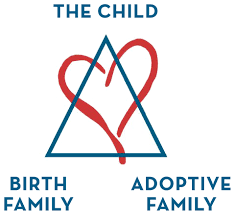
…but when it comes to adoption, negotiating the triangle shaped view is key.

What Is the Adoption Triad? | Birthmother Ministries

The theory of the Adoption Triangle was introduced early on in the council training. As prospective adoptive parents at the line we are most aware of and keen to establish the line that will connect us to our adoptive child – but what of the other two lines? You don’t get far in the process without it becoming clear that our adopted children do not come to us in a vacuum. Long gone are the days of covering up adoption, hiding it away, re-writing history – so in what way will we carry history – or in our case her-story within our family as a part of our daughter’s life?

Our children have a birth family – and always will. That line on the triangle from child to birth family is not one that is cut when the adoption papers are signed. A birth family is not a mere back story with certain therapeutic properties, some helpful medical information and a neat THE END on the final page. Our child’s birth family are an ongoing reality in our children’s lives and therefore in our lives. Which brings us to the third line of the triangle – our relationship to our child’s birth family.

In our training we were encouraged to enter into this dynamic with compassion and empathy. The focus was on our initial reactions during the matching process when we wade through reports inevitably full of negatives: failures, shortcomings, neglect, cruelty… We were also talked through the benefits of a face to face meeting with birth parents – which in our case is yet to happen – and introduced to the formal / agreed elements that are put in place with your social workers: indirect letter box contact and possibly direct sibling contact – depending on circumstance.

But what I am now (6 months in) starting to consider more deeply is the non-formal, ongoing nature of life in the triangle and what that might look like through the years. And what I am realising is that the answer to that question is largely up to me – at least for a quite a few years to come. How accessible do we make the life story book and more importantly how accessible do we make ourselves to our child on this topic? How much will we talk about birth family and what tone will we strike? Do we put pictures of them up on the wall? How much, if anything do we make of birth family birthdays?

These are just questions at this stage – no answers yet. But perhaps more important than the answers – which will inevitably vary from family to family and through various life stages – are the emotions and motives underlying them all.

Here – as in all therapeutic parenting – I need to be self-aware and self-regulate so that, in due course I can help my little one negotiate these tricky emotions .

So what’s going on with me? Well I am going to be really honest here – and these are not things that I am proud to be typing! Here goes – I feel less secure as my little one’s mum when I receive news that her birth mum is doing well. Which therefore means that I feel ‘better’ when she is not doing well. I hate that I feel that way – but I do. And I think there are various reasons behind that.

Let’s start with guilt. I think I feel less guilty for having the privilege to call this beautiful person my daughter when the circumstances in her birth family match more closely the situation that she was taken out of. It is as if I need ongoing justification for having her, reassurance that I haven’t stolen someone’s child and be required to give her back, reassurance that I am not the bad guy. Because life seems easier when there are good guys and bad guys – particularly when we can cast ourselves as one of the good guys. But that’s not life – that’s a fairy tale version of life and I need to resist buying into it. I need to resist even when people do their best to cast me as the good guy: ‘She’s such a lucky little girl!” – because it is just more messy than that. We are not the happy ending – hey join my house at dinner time and that will becomes clear in a matter of minutes – because the story is still being written and I’m just glad I am in it!

And then there’s fear. Firstly fear that I am less of a mother to my daughter the more potential for mothering her birth mother shows. And linked to that is the fear that with an improvement in birth mum’s circumstances comes an increased likelihood that I will have to share my daughter in the future.

I’m so sorry – I warned you it wasn’t pretty! Please know that I see how ugly that all is. And I deeply believe that none of my children have ever been or will ever be mine to keep. I can do my best to keep them safe, keep them sure of my love, keep them warm and fed, but it is not for me to keep them all to myself.

If I am going to be able to walk my daughter through this, to hold her hand through all this, I need to get some things straight.

I need to know – because she needs to know – that her birth family does not diminish our family. It is because of her birth family that she is who she is and that is just the way we love her to be. To love my little one is not just to tolerate the presence of her birth family in our lives, to pay lip service to it, but to embrace it.

There is not a shadow of a doubt in my mind that my little one is any less my daughter because I didn’t give birth to her. The fact that there is another woman out there who gave birth to her and who loves her does not diminish or challenge that. Indeed, the better parts of me can see that it can only be good for her to be loved by two women and all the more so if I can love that woman too! Afterall, the empathy we were encouraged to have for birth families doesn’t have an expiry date.

Of course the wobbly parts of me (and believe me these are not reserved for adoptive matters, but roam freely all over my mummying) still have some questions. “Just because I am certain that she is no less my daughter, does it follow that I am no less her mother? Or is that up to her? Is she as stuck with me as my other children are?” And the answers? All I can offer as an answer is – we’ll see. Parenting is a high risk occupation – to love that much, in that way is a costly business – but boy is it worth it.

So yes, sometimes life can be a bit triangular and sometimes that can hurt. For example – in the midst of all the fun and celebration of little one’s birthday I hurt for her birth mum, and I hurt that I couldn’t even narrate the day of my daughter’s birth to her, and I hurt that I hadn’t shared in it. And that’s OK – because that’s what love does.

And of course, most of time life isn’t triangular at all – it’s just, well…….life shaped.

Melissa & Doug Shape Sorting Cube | Ocado

Mummy has a downstairs brain too!

So I lost it. She needed me to name it to tame it, to connect and redirect, to use my calm to calm her down, to be attuned, to respond to her cries/yells with empathy, acceptance and curiosity. She needed my mature upstairs brain* to bring peace and safety to her rioting downstairs brain.

And what did I do? I lost it.

Why? Because at the time my upstairs brain was not in the driving seat. Why? Short answer – because I am human. Longer answer: it’s Covid-19 season and my base level stress is elevated, my son needed squared paper and his downstairs brain was aroused with anxiety that he would get told off and that he wouldn’t get his work done; his brother’s downstairs brain was aroused because he is trying to totally sort out all his Lego and he couldn’t get some pieces pried apart and I have no idea what was going on with the little one – teeth, developmental stage, not getting what she wanted, frustration???? There was no way I could practically sort out everyone’s problems at once – let alone investigate and regulate everyone’s emotions. So when the little one shrieked in my ear and dug her sharp finger nails into my face in a twisting pinch I failed to parent therapeutically. I failed to keep my voice calm, and I could have been much gentler as I attempted to rescue my face.

And I’m going to struggle to type this – but here goes – THAT’S OK.

And I can only say that because an expert told me! I’m currently in the middle of a training webinar on De-escalation given by Jane Mitchell and not only have I been informed with brilliant, accessible information on the brain and our emotions, the affect of trauma, and how to parent wisely to de-escalate before things get out of control, but also wonderfully empathised with Mum to Mum. I haven’t finished it yet, but I know she is coming on to talk about the positives that come from careful repair work after some of our not so brilliant Mummy moments and also to the importance of self-care.

And so I am going to attempt to use my understanding of the brain not only to challenge myself as to how I might respond differently in the future, but also to recognise that Mummy has a downstairs brain too.

* You can find more about upstairs and downstairs brain online for example search ‘Dan Siegel – Name it to Tame it’ on YouTube.

A recommendation

I have just finished watching this interview and found it really helpful.

Some of it is Covid-19 specific, but actually it works out as a helpful summary/reminder of good patterns of regulating and relating before trying to reason and some great visuals on how the different parts of our brain work in times of stress. It’s about half and hour in total.

Diary of an Adoptive Family: Year 2 Part 2: It’s a match! October-December

Year 2

DAY 1

“So there is news, but it is complicated – but then it always is!”

These were the words of our social worker as she began to tell us about a potential match they had identified for us. Words spoken 6 months after we received the news of our approval as prospective adopters. Redacted CPR.

DAY 6 – whole family meeting with baby’s social worker and our ASW at ours.

DAY 14 – a chance chemistry meeting after a meeting between ourselves, baby’s social worker, our social worker and baby’s foster carers.

DAY 20 – Court decision re Foster to Adopt

DAY 21 – Planning Introductions and my first cuddle. Present: Chair, baby’s two social workers, foster carers, foster carers social worker, our social worker and us. Ooh and baby – not always the case, but practicalities necessitated it.

Year 2

Introductions and Coming Home, Contact and Court

Key ‘Introductions’ words: Exciting, intense, exhausting, lots of information, busy, back and forth, lots of people involved, lots of driving, closely planned, bonding time just the three of us: playing, getting to know you, learning, revelling…

DAY 34 – Introductions begin – see separate post

DAY 43 / Placement DAY – Baby comes home. Paperwork. Foster Carers pop by for first few days.

Days since placement 4 – We’re on our own! Registering with doctors, health visitors (NOTE: with the Strengthening Families team not your local health visiting team), dentists…

DSP 7 – Contact – see separate post

DSP 12 – Contact cancelled

DSP 13 – Court Decision re Placement Order

Key ‘Early Days’ words/notes: At home, time and space. Timing the rare little trip out with sleep time, following routine, growing confidence, guarded normality with the other children, social worker visits, lots of time just the three of us, cuddles and more revelling, joy and amazement, togetherness, memory making, guarding baby’s normal as much as possible, help from supporters to keep life going. Ups and downs; highs and lows: as naps or bottles were slightly mistimed or spot on; as weaning led to a constant mix of ‘successes’ and ‘failures’; as meetings pushed rhythms out of whack or a day just worked; as baby’s happy times coincided with the older children needing some time with us or just as baby went through her own ups and downs and we tried to understand. Quite a high level of social worker visits(at least weekly stat visits – but generally more), some keeping in touch with foster carers.

Year 2

DSP 19: Phone consultation with the Medical Adviser – this was really pleasant and gave me a chance to ask a question regarding something that had come up in a recent health visitor report. There was some confusion over which tests had been done and needed to be done, and what information I should or shouldn’t have – but we got there!

DSP 20: Contact

DSP 25: CLA review – Child Looked After review meeting. Present: Baby’s IRO, baby’s social workers (2 because she was still in foster to adopt) and our social worker. The meeting was at our home and we had met everyone before which was nice. The health visitor wasn’t there as I had only just been able to track the right team down! This meeting was chaired by baby’s IRO and reviewed how baby was doing in a number of areas and where we were in the process regarding matching panel, contacts, meeting birth family etc. The IRO’s knowledge of the whole birth family really shone through making sure the right questions were asked and that all the various needs were balanced.

The statutory requirements for CLA review meetings are that they happen within every 6 months but within 28 days when there is a change in placement. For us this has so far translated into 2 CLA meetings – one just after the initial placement with us – a foster to adopt placement; and one after our matching panel when it became an adoptive placement. We have one further CLA review meeting pencilled in for August (6 months after the most recent one) which will only go ahead if the Adoption Order has NOT come through.

DSP 25: Baby meets a grandparent! Grandpa was coming up to collect some Christmas presents and was able to stay with a friend of ours as it was quite early to have someone new stay with us. He was very respectful and kept his distance – no cuddles and always waiting to be reached out to – but it was really lovely to start integrating baby into the wider family.

DSP 28: Final Contact cancelled last minute. Find out more in my post on Contact, but this was definitely a low point!

DSP 40: A very different sort of Christmas! Our usual Christmas Day is to drive for 5 hours, followed by a week staying with family and being very busy. This year was completely different. It was wonderful to celebrate baby’s first Christmas with her and to make some at home Christmas traditions together – including a massive real Christmas tree.

At this point we did venture out and about a little more – going on a lovely New Year’s Eve walk in the woods with some friends and afterwards to a cafe, continuing our tradition of 10 years or so by meeting up with close family friends for a day just before Christmas and a trip to big brother’s school play. Baby even had her first trip into Asda itself – compared to the usual sit in the car for click and collect – as we had a prescription to pick up.

Main threads during this stage: An odd mixture of a bit more back to normal – a more confident sense of rhythm in our days and routines, a pause on contacts, fewer social worker visits due to Christmas holidays, and getting out a little more – and the ‘un-normality’ of Christmas – and a very different one at that – and school holidays etc.

Act 3: Yes! We’re very nearly there!

Back in May in the period immediately following Approval I compared the adoption process to a play in various acts.

Act 1 told two separate stories. Firstly – the story of a child, their birth family; and the social workers and courts involved in deciding what was best for this unique and special individual. And secondly the story of a couple going through the process of being approved to be adoptive parents. Both of these stories ended Act 1 at the same point – heading towards adoption – only to diverge again in Act 2. Although now swimming in the same pool these hitherto separate stories still had to wend their way towards each other through due process and good old fashioned patience. And finally the curtains fell on Act 2 – the inevitability of the intertwining of these stories crystal clear to the audience, but still tantalisingly outside the experience or knowledge of the principle actors.

And now the orchestra has started to play again, the audience have retaken their seats and the curtain rises on Act 3 in an atmosphere of delightful anticipation. The scene is set in the house of the prospective adopters. ‘Mum’ is knitting in the baby’s room with a sense of excitement that she has no foundation for other than the more hopeful / expectant tone of their last meeting with their social worker and… ? well let’s call it intuition (always easy with hindsight!). The doorbell goes and Mum heads down the stairs while Dad goes to the door. Hot drinks are initiated, small talk performed…. and then – off the usual script – the social worker asks: “Are you expecting anyone home soon?” “No”, she is assured, in fact there are after school clubs etc so we have a good amount of time available…And so it is that seated in their usual seats in the sitting room the prospective adopters finally hear the words they have been hoping for: “So there is news….. ” and the audience breathe a sigh of relief as the two stories they have followed for two Acts now collide for the very first time.

It’s not about me!

Written while waiting for a match

It is, of course, a good reality check. The Council are not looking for a child for us – that is not their job.

In an ideal world there would never be a child for us – because for there to be a match for us some very sad things need to have happened. Unlike approval – which can be a win win situation allowing everyone involved to be pleased with how things have turned out; when it comes to tracking and matching – a huge loss is at the heart of each and every hand played.

So this whole thing is not about me. BUT….

Just because this process is not about fulfilling our desires, that doesn’t mean that we don’t or shouldn’t have those desires. Those desires are exactly what the child we are waiting for deserves. The process needs to be child centred, but that child needs to have expectant parents at the end of the process. And that is us lot – the approved prospective adopters. Whatever the path that has lead us to this point – pain and loss, altruism, conscious choice or having choice taken away from you… – the point we are all at now is that we want to be the adoptive parents of a child who needs us. And that is good! Remember – we don’t need to have poker faces – we’ve played our hand! Impatience, excitement, fear of not finding a match, anticipation are all perfectly correct emotions for approved adopters to experience while they wait for a match.

While it certainly isn’t all about how we are feeling; how we are feeling is a vital part of the process. After all, should we really be offering ourselves up as parents if our intentions were totally dispassionate? Meh is not the appropriate attitude at this point!

If we felt just the same as we wait for a match as we would if we were offering our spare room to a friend’s brother on a ‘it’s there if the need arises, but we aren’t too fussed either way….’ basis would that not raise some troubling questions?

Would that be better than the ache I feel inside?

I don’t think so and nor do I think I should feel guilty about feeling deeply about this. I just need to learn to celebrate the ache and the anticipation while not feeling rejected or bruised when those emotions are given a back row seat in the proceedings.

And it is OK that that is hard. During the Assessment stages there are always marker posts ahead – even when progress is at its slowest each day that goes by is a day closer to where you are aiming for – and eventually the process takes you all the way to Panel. Once out the other side however, Panel remains the main reference point – it is just that now you are looking back at something getting further and further away. All future* marker posts that lie ahead of you are the ones that tell you how long you have remained unmatched since Panel.

So what with the emotions themselves, the awareness that they need to be kept a bit quiet while the professionals do their stuff and the unknown stretch of waiting ahead of you – well it all adds up to a very vulnerable position to be in. And that is not such a bad thing – what better way to prepare to nurture with empathy one far more vulnerable than I will ever be, whose little life may well have been a series of one unnerving experience after another?

*That is until that all important conversation with your ASW which starts “So there is some news…” Read on….

Approval Rating

This is a post I wrote back in May 2019. It felt rather raw at the time – more of a personal splurge – so I decided not to publish it. I have now revisited it and feel the following is worth sharing.

Coming back from my first ever support group meeting and with the radio offering little that grabbed me, I turned my thoughts to why I was finding life post-approval a bit of an uphill struggle.

Not the whole of life you understand, but just managing my emotions around the adoption …

Despite having thoroughly enjoyed the support group I drove away with a distinct knot in my tummy. With a long drive ahead of me, and nothing to distract me on the radio I fell to reflecting on just why that was. And what I found surprised me – hiding amongst the excitement, longing and impatience that I had expected to give myself a good talking to about I also discerned fear.

Hmm – fear. What is that all about? There was the obvious fear of a match never being found, but hiding in its shadow was a more subtle fear: the fear that each week and month of waiting was somehow undermining the approval; the fear that life post-approval was becoming life post-being approved of.

O.K. – so at least the fear is out in the open – now to address it.

Fear 1: “You’ll never get a match”
Well it’s basically far too early to cross that bridge and there are people who will help us cross it if and when we come to it.

Fear 2: “On second thoughts we don’t really want you.”
So I get it – a big part of the reason I am feeling like this is because I’m, well quite frankly I’m me! That is how my brain works. Many of you will be made of sterner stuff! But just in case I’m not the only worrier amongst us let’s just stick with it for a moment – aside from my personal proclivities, what else might be going on here?

Well, as I drove home that summer’s evening it struck me that, as well as the dramatic change of pace at this point in the process (as covered in my last post), there is also a pronounced change in atmosphere. Not a change from positive to negative – there are still lots of positives: excellent ongoing training, support groups, email updates, visits from our ASW, not to mention all the work that is going on behind the scenes. No it is more like a shift from a predominantly open atmosphere to a more closed one. From an atmosphere full of potential to one more densely populated with obstacles like courts and geography and competition. The positives that led to our approval are just as real as before of course, but they sort of go undercover for a while, while words like ‘vulnerabilities’ take centre stage.

To borrow some language from the world of the card table:

The cards are on table

As you near the end of the Assessment Stage and go through Panel everyone’s cards are laid out on the table. In the case of approval it is a win win situation and there are smiles and congratulations all round.

Playing it close to your chest

And then the game moves on without you. Your cards stay out on the table, while new players pull up their chairs and a new hand is dealt. In contrast to the last hand this hand is played very close to the chest, poker faces all round. Oh, and it literally becomes a competitive process.

Which is totally correct, understandable and necessary…

…AND just a little unnerving.

And that’s O.K. too.

Which brings us back to those knots of fear in my stomach as I drove home yesterday evening.

Is it understandable to feel an element of vulnerability as I experience this shift of atmosphere – yes I think it is. Does it follow that my fears are well founded?

No.

After all, it is often the case that the most innocent of things can cast a bit of a scary shadow when you find yourself in the unknown.

Is that our ‘approval rating’ going down? No silly – it’s just that we are not the right family for that child.

Are we slowly failing a probationary period? No – things are just moving a bit slowly in court at the moment.

Have we been ‘left on the shelf’ because we have fallen out of favour – forgotten and covered in dust like Wheezy in Toy Story 2? No – this is just the part of the story where you can’t quite tell how it is all going to work out.

So what to do? Well, take a bit of a deep breath, probably laugh at myself a little and keep going.

Book Review

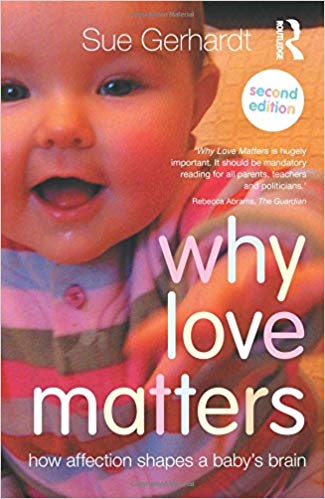
why love matters: how affection shapes a baby’s brain. Sue Gerhardt

Why Love Matters is not a quick or easy read, but it is fascinating. It is quite long and academic* and I had to renew it from the library several times in order to get it finished – but I’m glad I did! why love matters really challenges the separation we tend to make between the physical and the emotional and argues convincingly for the connection between physical affection and loving interaction, and the healthy development of babies’ brains. Our emotions are not to be treated as separate from and/or less significant than our physical well being, and certainly not ignored. Instead, we need to lovingly and carefully investigate emotions with our little ones and to give them permission to be emotional beings. We need to make it so very clear to our vulnerable children that negative emotions are not dangerous enemies that we would rather be protected from / not have to deal with. Such stifling of emotions merely intensifies and reinforces the hyper vigilance they are already having to deal with. Instead we need to enter into that emotional world with them and equip our children to identify them and regulate them and learn to see what those emotions are telling us. Our emotions don’t always give us the whole picture – they aren’t necessarily reliable witnesses or the right things to take our instructions from – BUT they are always vital clues to help us see and understand the whole picture. When it comes to emotions / feelings the following statements are gold dust to our children’s ears:

  • I want to hear you
  • I want you to tell me
  • I want to understand

Please note – I read this book some time ago now and do not have a copy – I made some notes which I have shared above, but they may not give a very good overall picture of the book.  

* By academic I don’t mean that it is all in professional speak – she is very good at putting things in layman’s terms – but the nature of the content she is covering is quite dense and scientific.

Book review…

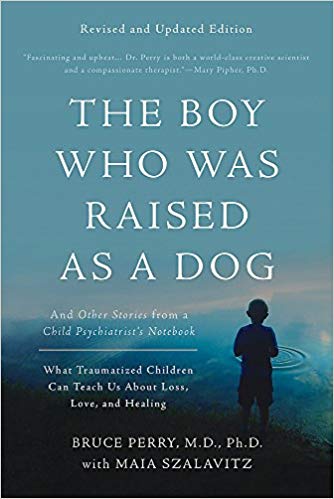
The Boy Who Was Raised As A Dog And Other Stories From A Child Psychiatrist’s Notebook – Bruce D. Perry, MD, PhD and Maia Szalavitz

This excellent book was recommended by Sarah Lloyd at a training day she ran on Building Underdeveloped Sensorimotor Systems (see below). Structured around real life cases it packs lots of science and theory into something very readable – I honestly couldn’t put it down. Not only is there the story telling around the individual children and their families, but also the narrative thread of how Dr Perry developed his Neurosequential Approach to therapy for traumatised children – sometimes flying in the face of the medical status quo. This approach focuses on how the timing (i.e. the point in the child’s development) of the trauma has specific affects on the impacts later on, and therefore on the best approach to therapy for that child. Explanations of the impact of trauma on how the brain develops and works are clear and specifically applied as Dr Perry compares various cases. Alongside the very clearly explained research the author’s genuine compassion and concern for each individual and for their parents and carers shines through.